Injection molding / Reference guide / 23 October 2026
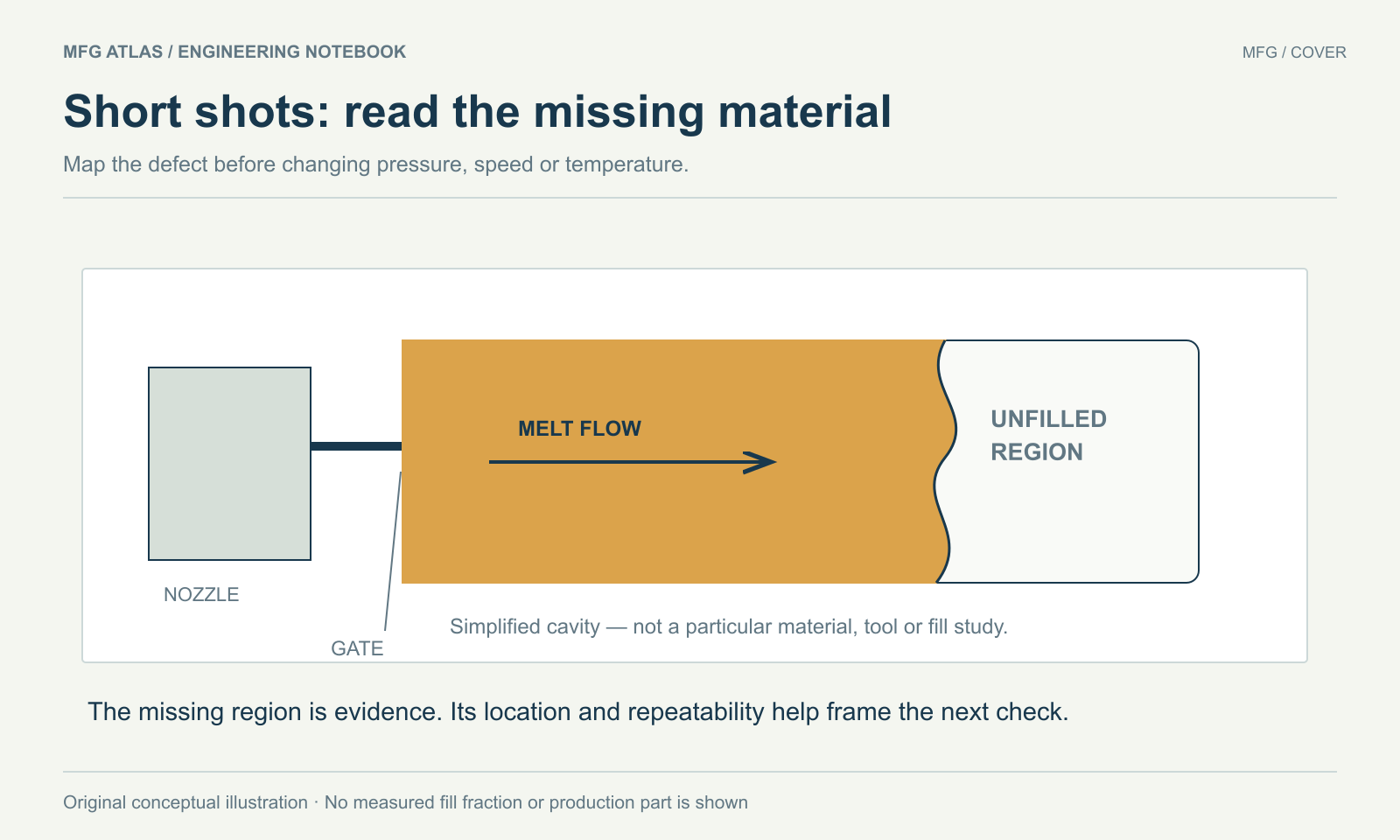
A short shot tells you where material is missing. A useful investigation adds when it happens, which cavities are affected and what the machine actually did during filling.
Scope. This guide concerns conventional thermoplastic injection molding. It organizes evidence; it does not specify a universal temperature, cushion, pressure or vent depth. The resin grade, tool, hot runner and machine control strategy determine the valid process window.
Before an intervention. Preserve the approved setup. Access to a mold, nozzle, heater or press requires the applicable OEM isolation and safe-access procedure. Never bypass guarding or reach into a running tool. Machine-specific energy control remains essential; see OSHA’s hazardous-energy reference.
1. Map the missing region before selecting a remedy
A short shot is an incompletely filled part. Autodesk’s troubleshooting guidance identifies several possible mechanisms, including flow restriction, hesitation, inadequate venting, insufficient delivered material and machine faults. It also distinguishes achieving fill from achieving an adequately packed, acceptable part. Completing the outline alone does not establish product quality. Autodesk short-shot guidance.
Keep representative parts and label the cavity, cycle sequence and gate location. Photograph them consistently, with an orientation mark. Record whether the same region is missing every time, whether every cavity is affected and whether the problem began at startup, after a material change or after stable running. Do not label an unfilled corner “poor venting” before checking other explanations.
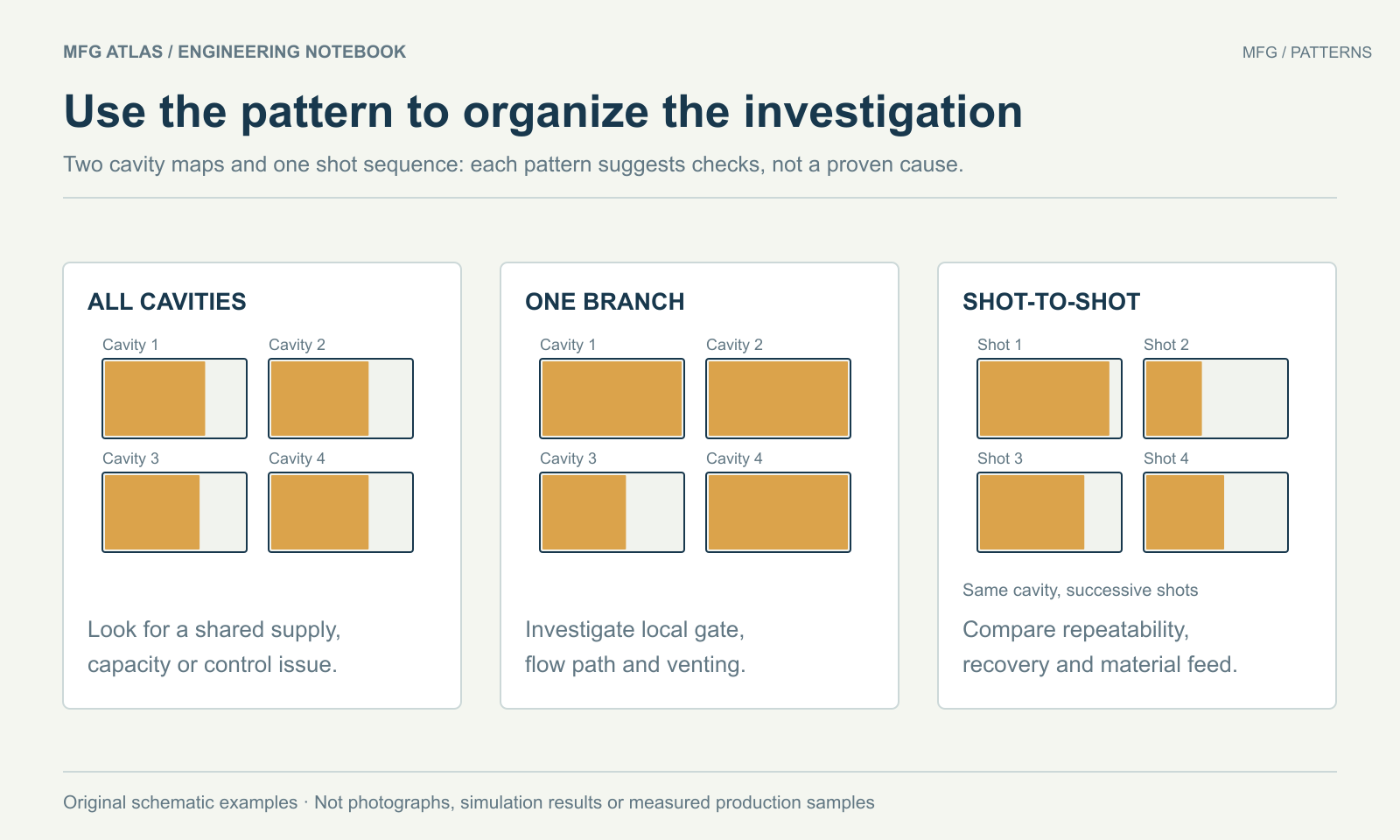
The three sketches are hypotheses for organizing work, not measured cavity-balance results. A shared failure invites checks of shared conditions; a localized failure invites comparison with a sound branch. Random variation makes repeatability especially important. A pattern narrows the investigation, while machine and tool evidence must establish the cause.
2. Save enough of the baseline to make a comparison
Keep the exact resin designation and lot, approved material-conditioning record, machine and screw identification, tool/hot-runner configuration and the setup revision. Capture actual values as well as setpoints where available.
| Record | Why it helps |
|---|---|
| Shot sequence, cavity ID and part mass | Separates repeatable geometry from changing delivery; compare with an established acceptable sample. |
| Fill time, transfer condition and screw positions | Shows when first-stage filling ended and whether the process matched the approved setup. |
| Actual injection pressure and velocity, with units | Distinguishes a requested setting from the machine’s response. Identify hydraulic, plastic or cavity pressure explicitly. |
| End cushion and recovery behavior | Provides evidence about repeatability; one cushion value alone cannot identify a check-valve fault. |
| Verified temperature and conditioning records | Connects the event to the actual material and tool state, rather than assuming the displayed setpoint was achieved. |
Do not transfer a numerical recommendation from one polymer guide to another resin. Toray’s AMILAN guidance groups short-shot causes across machine capacity, material flowability, gate/part geometry and gas venting. Its material-specific countermeasures illustrate why the applicable grade and tooling documentation must govern any adjustment. Toray, short-shot section.
3. Separate filling from packing
A finished short part can reflect an inadequate first-stage fill or a problem completing and packing the cavity. Changing several second-stage settings immediately can conceal that distinction.
RJG describes a controlled fill-only part as one way trained processors can examine the filling pattern separately. That is a deliberate process-development exercise, not permission to disable a stage on an unassessed production tool. Use an approved procedure and acceptance criteria; thin features, material behavior and the control method matter. RJG’s short-shot investigation guidance.
If an approved fill-only sample is available, compare it with the established baseline. If it is unavailable, say so and retain the distinction as an open question. Keep production rejects separate from intentionally incomplete development samples in the record.
4. Check whether the requested velocity was achieved
A machine can reach a configured pressure ceiling while failing to maintain the intended filling velocity. RJG explains that rising viscosity can expose this pressure-limited condition. The result is a reason to examine the available processing window and machine response, rather than assuming that a higher speed command will deliver a faster fill.
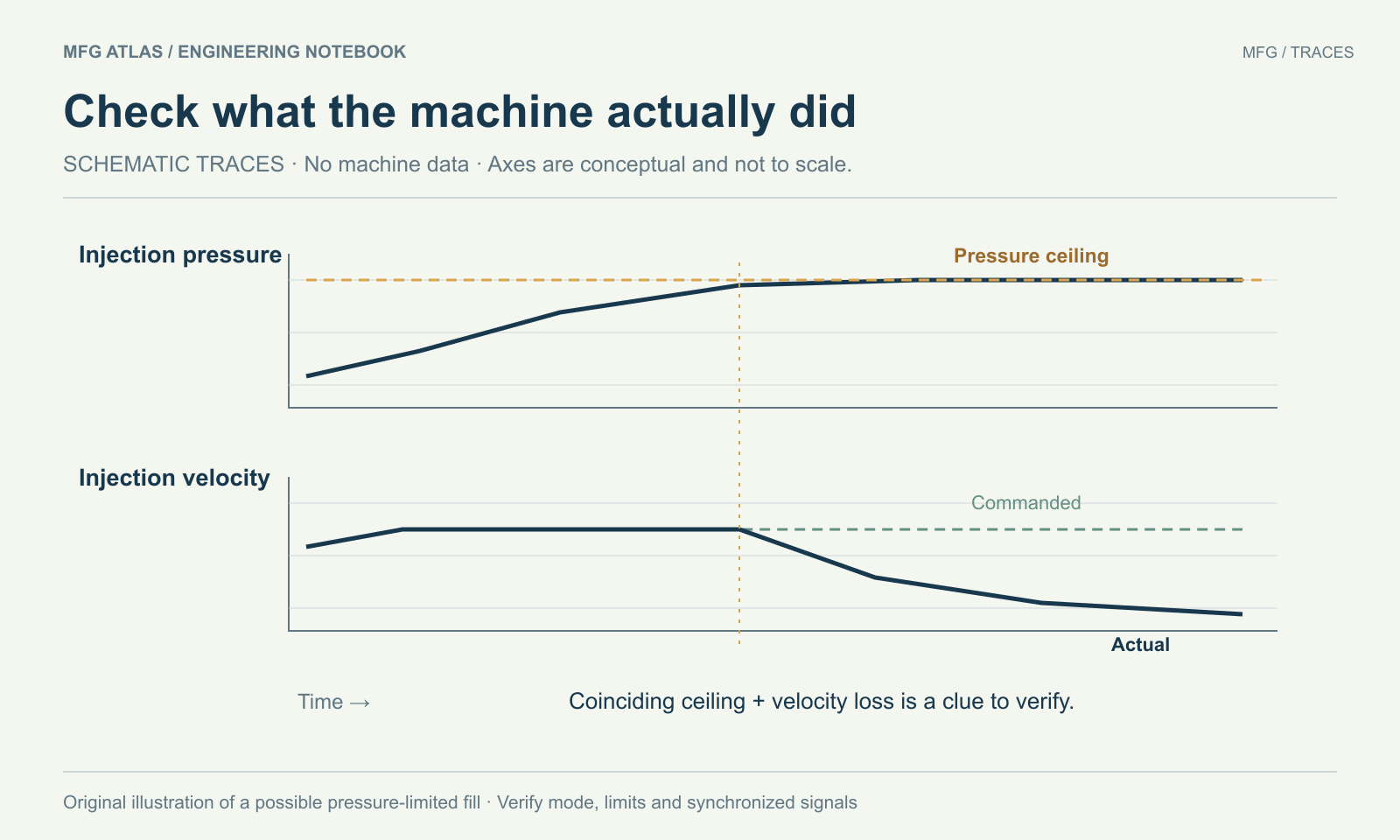
The curves above are invented to explain the relationship. They are not a capture from a press. In an actual investigation, confirm the operating mode, pressure definition, applicable limit and signal time alignment. A pressure plateau without the corresponding context can be misleading.
Celanese’s LDPE/EVA guide distinguishes insufficient material, obstruction, viscosity-related resistance, freezing and venting in its short-shot troubleshooting section. This supports treating the proposed causes separately. Its percentage fill targets, temperature guidance and vent dimensions are specific to its context; none are prescribed here for an unidentified polymer or tool. Celanese, troubleshooting guidelines, PDF page 5.
5. Make one trial answer one question
State the hypothesis before an authorized trial. For example: The affected branch may contain a local restriction because the other cavities remain consistent. Specify the evidence that would support or weaken it. An improvement after an adjustment does not, by itself, prove the original cause.
- Preserve the starting point. Save the approved process and the actual baseline, including the defect pattern.
- Select a discriminating check. Compare a suspect branch, a relevant synchronized signal or a material record with the baseline. Have qualified staff assess access and limits.
- Control the change. Use a bounded, documented intervention within the approved window. Record related variables that cannot be held constant.
- Wait for the applicable stable condition. Record the criterion used; avoid inventing a universal number of cycles.
- Assess the whole part. Review the specified dimensions, mass, appearance and other release criteria, not just whether the missing region disappeared.
RTP Company explicitly treats troubleshooting remedies as guidance for a complex process, rather than a guaranteed solution. A documented sequence and verification of unintended effects are more useful than a long list of simultaneous setting changes. RTP troubleshooting guide.
What a useful tooling or process handoff contains
Send the cavity map, labeled samples, material/conditioning details, setup revision, actual fill response and the results of the controlled checks. Identify what remains unknown and where the evidence points next. Escalate suspected gate, vent, heater or non-return-valve problems through the appropriate tooling or machine procedure; do not improvise physical modifications as a trial.
Discuss the pattern. Share non-confidential observations in the process optimization and defects forum. State the resin grade and whether the defect is common to all cavities.
Preparation. Published under the mfg account with AI-assisted research, drafting and original illustrations. This is a source-based reference guide, not a report of production testing or an independently reviewed process qualification. The source record below states the applicable sections and limitations.